Search Results for: label/Welcome Baby

Tutorials

Coffee-Sleeve-Gift-Card-Holder


Lunchbagcover Coffee-Sleeve-Gift-Card-Holder Pincushion Tutorial Scrappy Star Block Embroidery 101: Stitch & Quilt Along Pincushion & Needle Holder Ruffle Coin Purse

Holiday Vest for boys (or girls!) (tutorial)

6452456327_e9593ef3dd
This guest post is part of the Welcome Baby Tutorial Series!

Today we’re welcoming Julia from Blue-J Cottage.  My attention was actually drawn to Julia’s blog because of the adorable blue sewing machine she uses as her profile picture {you know I love cute sewing machines!}.  Not only does her blog have some great tutorials, but she even made her own wedding dress…now that is amazing!  So head over and say hello, and thanks to Julia for sharing this great tutorial with us!

Hi! I was so excited when I was asked to do a tutorial for the welcome baby series. My sister had a baby in June, so I have been making lots of baby things lately.

I tossed around ideas of what to do for quite awhile… Finally I thought, with the Holiday’s coming, it would be fun to create something for a little guy to wear. There are so many fun outfits for girls that the boys often get left out. Anyway, I decide to do a super cute Holiday Vest.
Holiday vest I made for my nephew!  Tutorial to come, on Friday!
This project would be best for an intermediate/advanced sewer, but I am going to try to describe every step as best as possible….so anyone who’s willing can follow along! I hope it’s not too much but mostly hope it helps!

Let’s get to it!

You will need:
Photo
Fun fabric for the vest
Plain fabric for lining
Batting (I used warm & natural; you probably could use something thiner)
Buttons
Elastic cording
Coordinating thread
Freezer Paper
Measuring tools of some sort (I used my rotary cutting mat and ruler; a yard stick/ruler would work.)
A flexible measuring tape will help too!
Basic sewing supplies

1. Decide how big you want to make the vest.
- I used a onsie as my guide. {which may not have been the best idea, it was a little small for what I wanted…}
- The most accurate way is to measure the actual child. {I would suggest waist (all the way around the largest part of their belly) and length (from shoulder to where you would like it to stop)}

Add, to your measurements, 2 inches to the width and 1 inch to the length. Divide the width in half and you have the size of the front and the back. Use the length as is.

2. Take the freezer paper out and make yourself a pattern for the vest using the measurements you took.

I started with two rectangles {for the front & the back} the length and width I wanted. Folded it in half.
Photo

Then I decided how large I wanted the arm and neck holes.
{you can measure from the shoulder to where you think it should stop, or just eyeball it.} I wanted mine to be 5″. I added one inch and cut a rounded arm hole. Make sure you leave room on the side {probably a little more than mine} to fit around the little guys body. Like a “gusset”.
Photo

I used a jar lid to make the neck hole. So it was even and rounded.
Photo

Then decide how you want the neck line and the bottom. I decided to make the neckline a “V” {instead of having a fold} and the bottom even {instead of having points.} You can do either. Just add them to your pattern now.

**I didn’t cut the front into two parts yet. I decided to wait until I cut the fabric before cutting it.**

3. Now that you have your pattern, we are ready to cut! Iron the shinny side down onto the fabric.
{If you have never worked with freezer paper before…it’s the best! You can iron it on then peel it right off and use it over and over! So helpful!}
Photo
Photo

After everything is cut… cut down the center of the front panels to separate them {I folded mine in half and cut}

You will end up with: 2 Front panels and a back panel of: main fabric, batting, and lining fabric.
Photo

4. It’s time to sew! Finally!! {Don’t you think prep takes too long sometimes?!}

Lay the two front pieces {right sides facing each other} onto the back piece. Pin them at the shoulder and sides, and sew! {1/4 inch seam allowance}
Photo

Layer batting and lining {wrong sides facing — right sides out} and then place the lining/batting front panels onto the back panel {right sides facing} Pin them at the shoulder and sides, and sew! {1/4 inch seam allowance}
Photo

Now you end up with this:
Photo

5. Layer the two layers together, front on the inside and the lining/batting on the outside {right sides facing each other}
Photo

Line up all of the seams and pin. {I did this at the shoulder, under the arm, at the “V” of the front and the seam at the bottom side}
Photo

Add elastic in one side of the front of the vest, pin in place. {excuse my already sewn picture….I got a little excited}
Photo

Pin all the way around the outside to prep for sewing. Leave a hole in the bottom center so you can turn it right side out.

No need to pin the arm holes, we aren’t sewing this just yet. {I must have been really exited because I didn’t get a picture of this. :( Sorry!}

6. Sew!! All the way around except the arm holes. Don’t sew the hole at the bottom shut!

7. Turn right side out and press. Make sure to fold and press the open seam at the bottom {where you turned the vest right side out} so it is ready to be top stitched shut.
Photo

8. Top stitch all the way around the outside. Double/triple over the elastic to make sure it stays put.
Photo

9. Now for the arm holes. Fold a hem under about 1/2 inch and pin in place. Hint: I did the main fabric first {it’s hard to get your hand in there to manipulate all of that at once.}.
Photo

Once main fabric was complete I added the batting/lining fabric to it and replaced the pin.
Photo

10. Sew the arm holes. Not going to lie, this is tricky… Just go slow and take your time and it won’t be so bad.

11. Press again.

12. Add buttons! I used a fabric marker to mark where I wanted the buttons to be.
Photo

Then simply hand stitched them in place.

You made it!! we are done!! And look how cute it turned out :)
Holiday vest I made for my nephew!  Tutorial to come, on Friday!
I hope you enjoyed this super cute Holiday Vest tutorial!

Please share a picture with me {bluejcottage (at) gmail (dot) com} if you end up making one! I love seeing what others make :)

Oh and if you run into trouble somewhere, don’t be afraid to email me for help…I’d be glad to!

Thanks to Jennie for allowing me to share this tutorial! And congrats on your baby Norah…she’s adorable!

Happy Sewing everyone!

“Little Chick” Baby’s 1st Christmas Felt Penguin Ornament (Tutorial)

Fullscreen capture 342013 100902 AM
This guest post is part of the Welcome Baby Tutorial Series!

I have the pleasure of introducing Jenelle from Echinops & Aster.  Jenelle’s blog is super cute {and new!}, and she has a Holiday How-to Series as well, if you’re looking for some more holiday ideas. So stop by and say hello, you’re sure to find some inspiration.  And thank you Jenelle for sharing this fun project with us!


Happy Holidays! I’m Jenelle and I am a crafter, sewist, and newbie quilter who blogs over at Echinops & Aster. I am so very happy Jennie asked me to put together a tutorial for the Welcome Baby Tutorial Series!
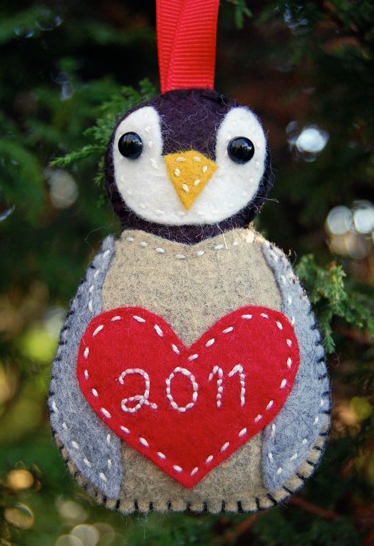
As this Christmas will be her little Norah’s first (such a cutie!), Jennie and I thought it would be the perfect time to introduce a holiday keep-sake ornament, marking that very first special Christmas for baby. The “Little Chick” Baby’s First Christmas Ornament is an easy to make, cuddly felt penguin sized perfectly for the tree, and includes options to personalize for your own little one.
"Little Chick" Felt Penguin Ornament    
Supplies:

- “Little Chick” Penguin Ornament pattern*
- Wool felt in black, dark gray, light gray (mine is more taupe), white, red, and yellow
- Embroidery floss (6 strand) or perle cotton (size 8 or 5) in black, white, red, and yellow
- Scissors
- Embroidery needle
- Regular hand sewing needle and basting thread
- Polyfil or other stuffing material (optional)
- 6mm safety eyes (recommended) or sew-on eyes**
- Ribbon, baker’s twine, or thicker perle cotton for hanger
- Removable/erasable fabric writing tool to mark felt for personalized embroidery

*Prior to printing your pattern, make sure in your printer settings that your page scaling is set to “none” or 100% to ensure the pattern pieces print true to size.
** Make sure if you use sew-on eyes or buttons that you keep your ornament out of little hand and mouths to prevent choking.

Directions:

"Little Chick" Felt Penguin Ornament

"Little Chick" Felt Penguin Ornament

- Cut out your felt pieces, cutting two pieces each for the body and middle. I like to use pins to secure my pattern pieces, but you could also trace the pattern using a fabric pen and then cut out.

"Little Chick" Felt Penguin Ornament

- Using the provided diagram as a guide (on the pattern sheet), stitch to the front body piece (with your white embroidery thread) the first middle piece, both wings, and the face (in that order) using a running stitch. Stitch the beak into place using the yellow thread. Also on the back pieces, stitch the second middle piece into place at the top using white thread.

"Little Chick" Felt Penguin Ornament  "Little Chick" Felt Penguin Ornament

- Using your erasable/removable fabric pen, write the year onto the heart piece. Embroider over your writing using white thread and a backstitch. Then stitch the heart onto the front piece using a running stitch all the way around. Your penguin should be slowly emerging!
"Little Chick" Felt Penguin Ornament
- Mark the position of the eyes using your fabric pen and either sew in place, or if using safety eyes, punch a small hole through the felt, using an awl, for the eye post. Secure with provided washer.

"Little Chick" Felt Penguin Ornament

- Embroider the tail onto the back piece using black thread and a backstitch in a “V” shape. You may also embroider the baby’s name onto the back piece, once again using your fabric marker to write the name, then backstitch using red thread over your writing.

"Little Chick" Felt Penguin Ornament

- Baste your hanger material into place on the wrong side of the front piece (between the eye posts) being careful to hide your basting stitches in the middle layers of the felt.

"Little Chick" Felt Penguin Ornament

- Lay the front body piece on top of the back (wrong sides together) and start blanket stitching around the body using your black thread, making sure to leave an opening if you plan on stuffing your ornament. Stuffing is completely optional, but makes for a more plush ornament. I like this pattern either way really.

- If you do use stuffing, finish by sewing around the edge, closing your opening securely.

And you’re done! This pattern makes the perfect little penguin to hang on the tree, but with some copier magic, you can enlarge the pattern pieces to make a softie as well. :)
 

Please feel free to let me know how you like the tutorial/pattern and of course Jennie and I would love to see your own finished “little chicks”, so make sure to post pics of them in both the Clover & Violet and the Echinops & Aster Flickr Groups. Thank you so much to Jennie and Clara for inviting me over and happy making!

I-Spy Baby Quilt (Tutorial)

2011-11-30_18-32-33_138
This guest post is part of the Welcome Baby Tutorial Series!

Our next guest blogger is Rhonda from Quilter in the Gap.  Not only does Rhonda have a fun blog,
but she’s extra brave and puts out a podcast as well!  I wish I had more time to listen, but the episodes I have found time to follow along with are great.  Especially if I can do some sewing or embroidery while I listen.  Just like having a friend in the room.  So, venture over, leave a comment, and listen to her podcast if you have a minute.  It’s a great opportunity to get to know a fellow quilter and overall great lady!

These are very exciting times – a new baby (the stunning Norah) brought into a loving home makes me smile. Jennie and her family are so deserving of such a blessing and that baby girl will certainly be loved! I am also excited because this is the first time I have been asked to guest blog – and to do a tutorial….well that is sheer bliss for me.
Let me start with a quick introduction. My name is Rhonda and I blog and podcast at Quilter in The Gap. The main idea behind my podcast is to introduce my readers to everyday bloggers like me and you (and yes my grammar is often this bad). I interview them and then share it with all who care to listen – hopefully generating more readers for those bloggers. I would love for you to listen and maybe even to interview you, the quilting/sewing blogger. So, hop on over (after you take a look at my tutorial) and let me know what you think. You can find all my episodes here.
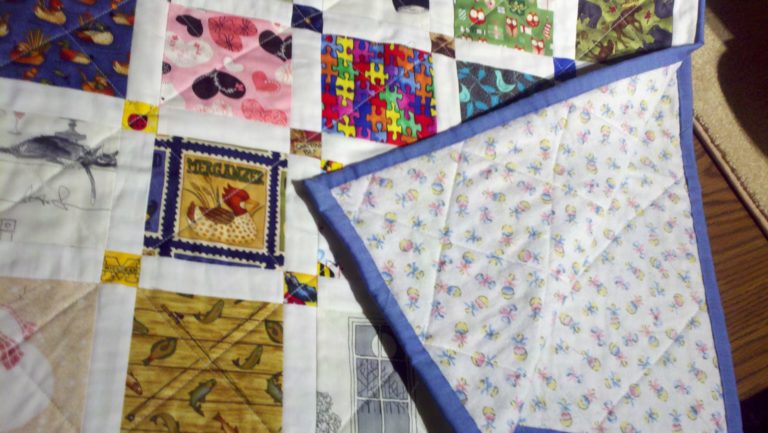
When I was designing this little I-Spy Quilt I had my new granddaughter in mind. She just turned 9 months old (yesterday) and will soon have a blast finding all the goodies on this quilt. I made it small enough for her drag around with her – once she starts walking. This would make a great gift for a newborn (could be used as a wrap) all the way up to a first birthday present – and maybe beyond.
I Spy….with my little eye….a bumble bee….
Enough rambling….let’s get started.

Quilt Details & Supplies Needed:

Finished Quilt Size: Approx. 40″ x 25″

Yardage Needed:
3/4 yd White Fabric
Various scraps for I-Spy Squares
1 1/4 yd for backing
binding fabric (yardage depends on desired width)

Cutting instructions:
40 – 4 1/2” I-Spy Squares (scraps are great for this project)
67 – 1 1/2″ x 4 1/2″ sashing strips (white in my case)
28 – 1 1/2″ I-Spy Squares (more scraps here)
2 – 1 1/2” x 39 1/2 strips for outside border (white for me) – not pictured
2 – 1 1/2” x 24 1/2 strips for outside border (white for me) – not pictured
30″ x 45″ backing piece (flannel was my choice) – not pictured
+/- 140” binding (width of your choice) – not pictured

I Spy…with my little eye…Bugs Bunny…

Assembly Instructions:
After all the cutting is done it’s time to start the first lay out of your quilt. I simply laid out the top with the sashing and small I-Spy squares so that I could make sure all the colors didn’t seem bunched together.

I Spy….with my little eye…a pink elephant…
Once I had a pleasing layout, I moved all the pieces to one side of my design wall. Now for you this might be an unnecessary step but for me (the UFO queen) I generally have several projects going at one time and need the design wall for multiple things. Please keep this in mind when you are looking at the various pictures (some may have only one row of blocks – that is because they are stacked)

Sew all the sashing pieces to the right of the large I-Spy squares and then to the left of the small I-Spy squares. Always press toward the I-Spy blocks in this step.
I Spy….with my little eye…a snowman….
Now join all the sashing strips to the bottom of the large I-Spy blocks. Press toward the large I-Spy blocks.
I Spy….with my little eye…a black cat…
Now separate your rows into chunks of blocks. Let me briefly explain why I do this. If you are doing a large quilt you will have long rows to sew together – leaving room for wavy rows. By sewing my blocks together in chunks I can eliminate one more place for error and the potential of seam ripping (something I loathe). Occasionally this will require you to change the way the seams are pressed. Just press as you go, and you will see how they need to rest in order to nest properly.
Sew these blocks into large chunks.
I Spy…with my little eye…Christmas owls
Combine chunks to make a quilt top.
I Spy….with my little eye…a rubber duckie…
Add borders. You can either the sides first (as I did) or you can add the top/bottom first. Regardless, add your borders. NOTE: If I am making a large quilt I will sometimes add my borders to my chunks before sewing them all together – yet another place to eliminate the potential for wave. This only works well if it is a busy print border where the seams won’t really show…but a tip to keep in your bag of tricks.
I Spy…with my little eye…plums…
Layer, quilt, and bind your quilt as desired. There are many great tutorials online for layering, quilting, and binding so I didn’t think I needed to re-write this portion. I decided to quilt mine on the diagonal – going through each block – I also like the weird “x”s this left in the borders.
I spy…with my little eye…a spool of thread…
I Spy…with my little eye…a quilt shop…
I spy…with my little eye…a yellow puzzle piece…
You can continue to add blocks and make this quilt as big as you would like. How much fun to sit under a large quilt and play “I-Spy” with your kids or grandkids (btw, grands are much more fun than the first set). A friend of mine suggested saving scraps from various quilts you make and putting them into a quilt like this. She called it a quilt of “fabrics she loves” – what a great idea! I hope I gave you a little inspiration…have a great day!

Burp Cloth and Onesie Gift Set (a tutorial)

WelcomeBabySet
This guest post is part of the Welcome Baby Tutorial Series!

Our next guest blogger is Chrissy of Sew Lux Fabric & Gifts.  Not only do Chrissy and her mom have a great fabric shop {and of course, I love that she works with her mom!}, but she also blogs lots of fun and easy projects on the Sew Lux Fabric Blog.  And she’s got a great one for us today, a great baby shower gift of a burp cloth and personalized onesie.  So make sure you check out the great fabric selection, and stop by her blog to say hello too, and thanks Chrissy for sharing with us!

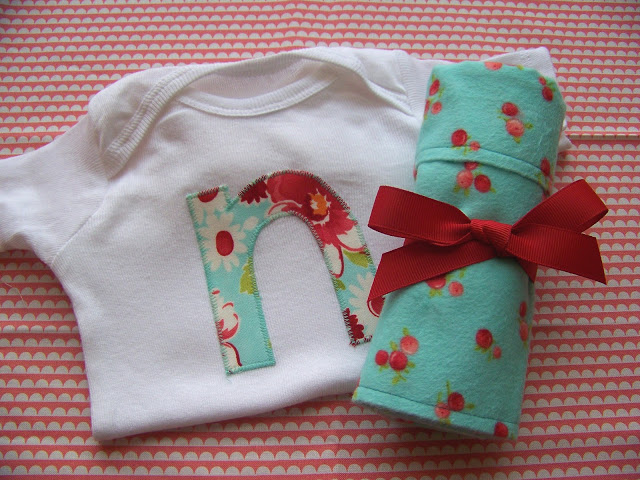
Hi everyone!  My name is Chrissy and I co-own a little fabric shop, Sew Lux Fabric, with my mom and I blog here.  I was so excited when Jennie contacted me about participating in this tutorial series.  Of course, I agreed to help and am happy to share two quick projects with you today.  So, let’s get started making this cute little gift set that includes a flannel burp cloth and personalized onesie.

First up, the flannel burp cloth.  You’ll need one 1/2 yard of flannel (18 in x 44 in).  For this project, I am using the super soft Ruby Quirky Aqua Flannel.

The first step is to trim off the selvages and straighten up the long edges.

Next, starting on an 18″ wide edge, fold over one edge 4.5 inches (wrong sides together).  I used my ruler to make sure I was straight with my fold.

Press the fold and pin the folded section down to hold it in place.

Now, place the flannel wrong side down and fold the pinned edge up 8 inches. (Right sides will be together.) Use your ruler to check the length.

Pin along the edges on both sides.

Next, measure 4 inches above the first folded edge, again using your ruler as a guide.

Bring the fabric over the ruler.  Carefully remove the ruler so you keep your folded section nice and even. Press the fold.

Make sure to overlap the section that is folded up from the bottom with the section folded over from the top.  Trim the excess fabric away, leaving a 1/2 to 1 inch overlap beyond the folded edge.

Pin all the way up both sides.

Next, stitch the sides closed.  I used a 1/2 inch inseam here. Make sure to backstitch at the beginning and the end.

Clip the corners.  Be careful not to clip the seam stitches. :-)

Now, you are ready to turn your burp cloth right sides out.

Carefully push the corners out.  (I like to use a bone folder from my papercrafting supplies – it isn’t sharp so I know I am not going to tear through a seam. :-) Press the edges well.

Pin all the way around again. :-)

Topstitch around the outside edge.  I used a 1/4 inseam and switched to my 1/4 foot on my machine.

Once you are done topstitching the outer edges, pin the flap down to keep it in place.

And then topstitch the flap down.

Next, measure the distance from the outer edge to the flap topstitching.  (Mine was about 4.25″.)

Using the measurement you just took, mark the other side of the burp cloth with a disappearing ink pen. (My line is kind of hard to see in this picture, but the marker is pointing to it.)  Your lines should be the same distance from both outer edges. Pin along the line to keep things in place.

Stitch along the line.  (I switched back to a clear foot for this as it makes it a little easier to see where I am going. :-)

You’re all finished!  A soft and cuddly burp cloth.

Now, let’s make the personalized onesie! You’ll need a onesie, a 4″ square of lightweight fusible interfacing, a 4″ square of fabric, FrayCheck, fusible web tape, and coordinating thread.

The first step is to create your pattern.  You can print a letter out or draw your own.  I prefer to draw my own.  I first drew two lines with my ruler 3.25 inches apart and then sketched out my letter with a pencil.  Once I was happy with my letter, I went over the outline with a marker. Trace the pattern onto the WRONG (bumpy) side of a piece of lightweight fusible interfacing.

Fuse the interfacing to the back of a piece of fabric. Bumpy side and wrong side of fabric together! I am using Ruby Swoon Aqua.  Note – your pattern should be backwards when looking at the wrong side of the fabric.  It will be correct from the front.

Cut out the pattern and FrayCheck the edges.  (FrayChecking the edges is optional, but I always do this as I think it keeps the edges nicer longer.)

Position the letter on a onesie or shirt and tack it down with some fusible web tape.  You may want to hold up the shirt to make sure you got it on there straight.  Just sayin’ ;-)   Adjust if needed.

Whenever I machine applique, I always adjust my stitch length.  The photo below shows the regular/default setting for the zig zag stitch on my machine.  It also shows how I prefer the stitches when I machine applique.  I shorten the stitch length and density … of course, this is personal preference.  (Click on the photo to enlarge.)

Ok, let’s stitch it to the shirt. Take it slow and keep the needle in the down position.  Pivot often being careful not to stretch the shirt. I like to use a clear foot so I can see where I am going.  On a tiny little onesie, this can get a little tricky keeping the rest of the shirt out of the way, but just take your time.  :-)

When you are done, clip the threads and press.  Cute, right?!  :-)

Now you have a fun little gift set for the next new baby in your world.

I want to thank Jennie again for having me guest post today.  I am so excited for Jennie and her family’s new precious little addition … congrats y’all!  :-)

I hope that you all enjoyed my project tutorials.  I’d love for you to stop by and visit me sometime and join in our Sew Lux Stitch & Share Challenges.

Happy Sewing! :-)

She’s Here!

Hi everyone,

Just stopping by to let you know we’ve welcomed our little girl this weekend!  We’re now home from the hospital and recovering nicely. In blogging news: the Ruby market tote post will also be delayed until Wednesday, but will continue; and there will be more great baby guest tutorials and a few other things in the meantime too!  I’ll be back with photos in a couple days.

Easy Onesie Tutu (a tutorial)

IMG_1566 (Large)
This guest post is part of the Welcome Baby Tutorial Series!

Today I’d like to welcome Kat from Diary of a Flutter.Kat. Kat is an Australian quilter and sewist, mom of two beautiful little girls, and just all-around creative. On her blog you’ll find a variety of pretty tutorials, interesting series, inspiration, and encouragement.  She also has a shop full of personalized of kids wear, that would make great gifts as well.  So, stop by and say thanks for sharing one of her great tutorials with us!

Hi Everybody!
My name is Kat.
First up I’d just like to thank Jennie for having me over to visit today & contribute this awesome series! And of course congratulations to her as well. It sure is an exciting time for you at the moment Jennie and I know we all wait to hear the happy news of baby’s safe arrival :)

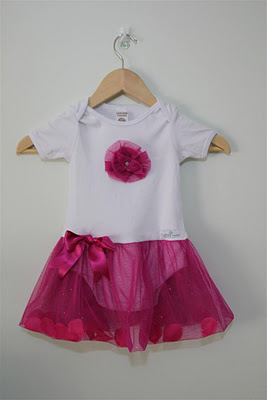
Today I would love to show you all how to make a super easy onesie tutu…

Today I’ve just made it using a very basic white onesie that I happened to have on hand, but these also look fabulous when made with a coloured/printed onesie, and you can really make the top look so pretty by adding more rosettes, some ribbon etc…

I also like to make a coordinating hairclip or headband and wallah – such an easy princess outfit (which would have cost me less than $10 to make – bonus!).

You can use the same technique to add a cotton skirt as well – just hem the bottom for that rather than doubling it over…
Soooo many possibilities!

So, to make this onesie tutu you will need:
**  A basic onesie in the size of your child – I was using a size 1 here.
**  Some soft nylon netting – WOF x (double the length you would like it + 1 inch) – I’ll explain this more in a moment.

Optional additions for embellishments
**  Some petals or washable flowers/decorations for inside the skirt (found these at my $2 store)
**  15+ inch length of satin ribbon
**  24 x 4.5 inch length of netting for the rosette
**  fabric glue
** small circular scrap of felt
**  rhinestone or decorative button
**  small scrap of velcro (hook & loop) (if making rosette removable for washing)

Step 1: Working out your measurements & how much netting you will need…
To do this you need to measure the length you would like the skirt to be on your child – so from their hip down to the length you want.
Then double this measurement & add an inch for seam allowance. That is the length of fabric you need by WOF.
E.g. my daughter needed hers 9 inches long – so I cut my nylon 19 inches long by WOF.

Step 2: Cut your netting…
The easiest way I found to cut mine was to use my rotary cutter & cutting mat (I’m a quilter can you tell ;) ) But if you don’t have these tools you can just use scissors & a ruler.

This is how I cut mine:

Put the surplus aside for your rosettes if you are choosing to make those.

Step 3: Making the skirt band…
Now we need to join the short ends of the netting together so it is in a continuous circle. I used my overlocker/serger (just because it’s a new toy & we’re still in the honeymoon phase where I want to use it for everything ;) ), but if you don’t have one of these then you can just sew a simple 1/4 inch seam – netting shouldn’t fray.

sew down the short sides to join

Now we need to fold the skirt length back over on itself again and if you are using petals down in the skirt you can stuff those in now…

You can see that I found it helpful to pin the netting together at the bottom fold to stop it moving around everywhere.

I then serged the top opening closed (round in a circle with only 2 layers together – not all 4 layers closed like I have pictured below – it just looks like that since it’s all a circle).
This step isn’t entirely necessary but I found it made it easier for me to work with tutu that’s all.

Now we want to gather the top of the skirt. So increase the stitch length on your sewing machine to the longest length it goes (mine is 5) and sew a scant 1/4 inch gathering stitch around the top of the skirt…

Once you have finished cut off your thread, then gently pull your bobbin thread at each end to gather up your skirt. You want to make it so that it is about 1.5 inches bigger than the width of your onesie and make sure that the gathers are very evenly distributed around the skirt…

Step 4: Joining the skirt to the onesie…
First we need to draw a line on our onesie where we want the skirt to go across. I have to confess that I just used a regular pencil for this (look away sewing police) but you can use a chalk marker or whatever fancy erasable sewing notion that strikes your fancy ;) . The mark is going to get sews into a seam so it’s not that big a deal to use a pencil…

Draw your line about waist height – I actually drew mine a little low in this example so don’t copy my photo exactly… I should have done it about an inch or so higher than I did… more waist height.

Then take your tutu piece and place it upside down over your onesie over the line like so…

Now we want to pin the tutu to the onesie at each side seam. Only 2 pins total. Too easy.

**  Please just note: because we made the tutu wider than the onesie it won’t fit exactly. Therefore you just need to be careful to make sure that when you pin it at the seams half the skirt is at the front & half at the back. Then as we sew it we are going to gently stretch the onesie to match it up to the tutu.
We do this so that it has some give and that when the baby wears it a) the stitches don’t all get stretched while they wear it and get broken & b) so it’s more comfortable for the baby.

So with that in mind are you ready to sew your skirt to onesie? So close to finishing this part!

Reduce your stitch length back down to about 2.5-3. If you have a stretch stitch you might want to use it now… and slowly sew the tutu to the skirt using a very scant 1/4 inch seam or 1/8th seam and also gently pulling the onesie so that it stretches to the same width as the tutu as you sew.

I start at one seam & work my way around…

Make sure that you have the arm of your sewing machine in between the top & bottom layers of the onesie at this point so that you’re not accidentally sewing it completely closed ;)

Also make sure that you reverse your stitches at the beginning & end to secure them in place.

Once you have gone all the way around then fold the bottom part of your onesie over so that you can see the underneath of the seam you just sewed and so that you have the tutu trapped in between the fabric of the onesie.

Sew around again, this time using a generous 1/4 inch seam, so that the top tutu seam is now trapped nice & neatly in the onesie… hopefully you can just see what I mean from the photo…

How seam looks inside after sewing

Clip your threads, turn the right way out and you should have a lovely onesie tutu to admire!

Now just for the decoration…

Step 5: Embellishing your tutu…

To make a rosette find a long scrap of netting. Mine measured 4.5 inches x 24 inches but it doesn’t have to be exactly this. Fold it so that you have doubled the long sides over…

Increase your stitch length back up to it’s maximum and sew 1/4 inch gathering stitch down the whole length…

Gently pull your bobbin threads so that you have tightly gathered up the netting as much as you can & wrap the bobbin threads around the bottom of the rosette…

Now at this point I decided that I wanted to make my rosette removable using a velcro attachment, so I cut a circle of felt and glued my rosette onto it using fabric glue, then I glued a piece of velcro (hook & loop) onto the back of the felt.

If you choose to make yours removable also then please just be aware that it could form a choking hazard for infants under 3 – so you need to do so at your own risk…

Otherwise you can glue it onto the felt then hand stitch it onto your onesie.

Then I sewed the soft piece of the velcro into the middle of the onesie where I wanted the rosette to sit (I eyeballed it) and glued a rhinestone to the middle of the front. You could just as easily sew a decorative button onto the front instead which will help keep it all together.

You could use a brooch if you wanted instead of the velcro – but I wasn’t keen to do that to Abbie’s because knowing her she would figure out how to undo it and stab herself with the brooch needle!

Yay our rosette is finished:

If you would like to add a ribbon to the tutu then tie a coordinated satin ribbon into a bow & handsew it on.

Step 7: Stand back & admire your cute cute creation!

Now at this point I would usually show you gorgeous photos of my beautiful peaches & cream model showing off her new wears, but unfortunately yesterday she just wasn’t playing the game…

Have you ever seen such an attractive face on a tutu’d princess?! I think not…
Poor tired Abbie was so.not.interested in playing to the camera for Mummy!
A little too much “it’s my party & I’ll cry if I want to” and a little less of her usual “look at me I’m a beautiful princess” poses!

Even when bribed with chocolate this was the best I could do I’m afraid…

 half a smile with a mouth full of chocolate and a face full of tears…

These were minus the bow too – oops, my bad. You’ll just have to use your imagination ;)

Anyway thanks so much for having me to visit today & I really hope you have fun with making a gorgeous tutu!

Feel free to stop by my blog & say hello, I’d love that!
I’m having a special feature linky party today too which might be of interest to you called “Nosey Parker in the Neighbourhood” – it’s all about getting to know other bloggers in our crafty community, so feel free to come & check it out and link up if you can :)

Take care

Not Your Average Nursing Cover (tutorial)

nursingcover2
This post is part of the Welcome Baby Tutorial Series

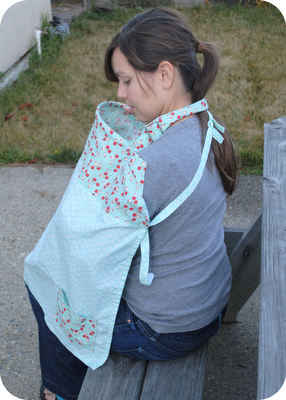
Here is my tutorial contribution to the Welcome Baby series.  Before I had Silas a nursing cover was high on my priority list of things to own for a baby.  I bought one from a shop and loved it, at first.  The more I used it, the more I thought of ways I would like to tweak it, to make it really perfect for me.  The biggest addition to this cover is the second strap, it is positioned lower and when draped over the shoulder will help keep the cover in place, even with a wiggly baby {with my previous cover I found myself sitting with the corner pinned to the chair to keep myself covered!}.  Enjoy!

For the nursing cover with the contrast piece on top, you’ll need 3/4 yard of body fabric and 1/3 yard of contrast fabric.  If using just one fabric, you’ll need about a yard. {And yes, there really is a baby under there…}


Read all directions before beginning.  Cut the following pieces {note: WOF = Width of Fabric}:

Fabric A (body):

  • 1 – 20″ x 36″ for body
  • 2 – 2″ x WOF into
    • 2 – 2″ x 30″ for ties {tie size may need to be adjusted based on the size of wearer and personal preference, I ended up trimming mine down to 18″ so there was no extra.}
    • 1 – 2″ x 12″ for Velcro loop

Fabric B (contrast):

  • 1 – 8″ x 36″ for top
  • 2 – 2 1/4″ x WOF into:
    • 2 – 2 1/4″ x 30″ for  neck
    • 2 – 2 1/4″ x 7″ for neck
  • 1 – 7″ x 8″ for pocket

Other supplies:  12″ of flexible boning {can be bought by the yard from your local fabric store}, 2″ of Velcro, and a 1 1/2″ set of rectangle strap slider and rectangle ring for the neck strap.

Note:  For this cover, I’ve replaced the D Rings with a sliding strap.  While the D Rings are on almost every nursing cover I’ve ever seen, they did not work for me, they constantly slid out of place and got tangled up, I ended up just tying a knot it the strap.  Also, I did not like the tail of the strap hanging down.  The sliding strap solves both of these problems.

Begin by sewing the 8″ x 36″ piece to the 20″ x 36″ piece with a 1/2″ seam allowance.  Press the seam open and turn the raw edge under, top stitch in place.  The piece should now measure about 27″ x 36″, if using only one piece of fabric, omit this step.

Note:  I found that the top corners of the nursing cover didn’t have any benefit, so I’ve removed them.  I thought this made it look a little more like an apron, not just a sheet.

Next, set the main body aside and make the neck strap.  Cut the two 2 1/4″ x WOF into two 2 1/4″ x 30″ for  the adjustable slide neck strap and two 2 1/4″ x 7″ for rectangle ring side.  Sew the two sets of strips right sides together, then turn inside out.  Turn under one end of the 30″ long strip and stitch in place.

Wrap the end around the center bar of the sliding rectangle and stitch in place.  Slip the other rectangle onto the strap.  Fold the long end around the rectangle and over the center of the sliding strap.  Set aside.

Next, create a casing at the top of the body by folding 1/2″ under, pressing, and then folding another 1″ under.  Pin in place.

Measure about 5 1/2″ from each edge and pin the straps in place under the casing.  The front of the strap should be facing out.

Stitch the casing closed and stitch the straps in place.  Next, feed the boning into the casing,

Fold the straps up over the casing and pin them and the boning in place.

Stitch the straps and boning in place simultaneously.  You should be able to stitch through the boning if you’re using the webbed-type boning I am, if not, secure the boning according to the manufacturers directions.

Using two 2″ x WOF strips, create the ties.  Fold the strips in half, right sides together, then sew 1/4″ from edge, press the seam open.  Then turn the tubes right side out {in the photo is a picture of my nifty turning tool, makes it much easier!  Another option is to use a safety pin to turn it right side out}.  Press flat with the seam in the center and top stitch 1/8″ from the edge.

Sew a square of the hook side of the Velcro to the end of the 12″ strap.  This will be used to keep the nursing cover rolled for storage.  Hem the angular sides of the nursing cover by folding 1/2″ and then folding a second 1/2″.  Tuck the strap under the center of the angled edge and stitch in place as for neck strap {I put mine on the left side of the wrong side of the nursing cover}.

Use the remaining pieces for the long ties and position at the seam of the upper and lower portion on the straight side of the nursing cover.

Note: I made my straps out of one 2″ x WOF strip because I only wanted them to be 18″ long each, and they tie together in the back with just a small amount of excess.  These straps are sewn to the upper side of the body of the nursing cover {see next photo}.  These straps will fall around the shoulders of the wearer.  I found that as my little one got bigger and more curious he tried to pull or kick the nursing cover aside.  I often sat with one shoulder up against the chair to pin the side of the nursing cover back.  These straps will hold the cover in place.  The length will vary depending on the wearer, but if they are kept shorter they will not create much extra bulk when the nursing cover is rolled up.

Hem the bottom of the nursing cover as sides.  Add the optional pocket by hemming the 7″ x 8″ rectangle of contrast fabric to 6 1/2″ x 5″.  Sew it to the right side of the nursing cover 1 1/2″ from the side and bottom.  Note:  My original nursing cover came with a terry cloth pocket sewn into the corner on the wrong side.  The claim was that it was to store nursing pads or be used to wipe baby’s mouth.  However, it was hard to get to and small for a pocket, and I didn’t want to use it to wipe baby’s mouth as the entire nursing cover would need to be washed.  Therefore, I’ve replaced it with a contrast pocket on the outside that is large enough for a small burp cloth or nursing pads.

To roll the nursing cover, fold the side without the extra tie over to the neck strap.  Then fold the bottom up to meet the top edge, and fold in half in the same manner again.

Then, starting from the folded edge, roll the nursing cover.  Wrap the closure strap around the cover and mark the spot for the loop side of the Velcro.  Stitch the Velcro in place and the nursing cover is compact and ready to go!

nursingcover

If you make one, we’d love for you to share photos to our Flickr group too!

Kim’s Welcome Baby Guest Post

IMG_4512
This guest post is part of the Welcome Baby Tutorial Series!

Our first tutorial guest is Kim from My Go-Go Life.  In all honesty, I’m less acquainted with Kim, even though I’ve been following her blog for a while.  However, her blog is packed full of inspiration in all shapes {and quilty} sizes.

Hi, I am Kim from My Go-Go Life.  Thank you Jennie and CONGRATULATIONS!!!! I am so happy to be invited to guest post on something I really love to do, make baby items.  I  have always enjoyed making and giving bibs. Bibs are so very useful and can be made easily and less expensively than purchasing them.

You can start with either a bib you already have and love by tracing it (adding in a seam allowance) to provide a pattern or you can use the pattern I have been using for years. There are two sized patterns I have. One for smaller babies and one for bigger babies into toddler years. For this tutorial I will be using the pattern I have here.

After you have your pattern printed , line it up and tape it together

If you are tracing your own, feel free to skip ahead :o )

Cut it out

I am making the smaller bib, and I will be making it with two super cute fabrics

Right sides facing sew the two pieces together

Flip the pieces over and topstitch

Place the sewn piece on top of your backing right sides facing. You can use chenille, minky or fleece. If you are making a reversible bib you can add a layer of flannel in the middle for absorbency.

Pin the pattern down

Cut out the bib

At the top of the bib leave an opening to be able to turn the bib right side out

Sew around the bib using a 1/4 inch seam, starting and stopping at the top of the bib

Pin the top opening together

With a coordinating thread topstitch around the entire bib

The closure is up to you. You can use velcro or snaps. I have a standard size snap press but I was at my local fabric store and saw their new baby section and bought this hand held snap press. They even have poly resin snaps in different colors. Pretty cool!

You will need two backs and one male and one female piece

Push the back into the end

this is how it will look on the opposite side

Place the male piece on top

and let the snap pliers to do the work!

Repeat the process fro the female side and you are DONE!!!!

You can make these bibs as simple or a fancy as you like.

Happy bib making!!!!!!!
Kim :o )

Welcome Baby (Tutorial Series)

button
This guest post is part of the Welcome Baby Tutorial Series!

Well, I’m starting to count down the days!  Baby should be making her appearance any day now.  So, to help us celebrate {and keep this blog interesting}, I’ve asked a few blogger friends to share some fun baby tutorials with all of you.  So check back each week for a new, baby {and kid} themed tutorial.  Here is the tentative schedule:

Enjoy.